If you are a new or commencing researcher your should be using your contacts to get advice on appropriate places to publish. These include:
Scopus and Web of Science databases have search options that can identify potentially useful new contacts in your field.
If you are early-career or trying to quickly advance your career, it is important to publish in high-impact journals.
Choosing the right journal to publish your research in can be pivotal to the success of your output.
Unfortunately, there are some journals that are what are termed as "predatory", and as such should be avoided.
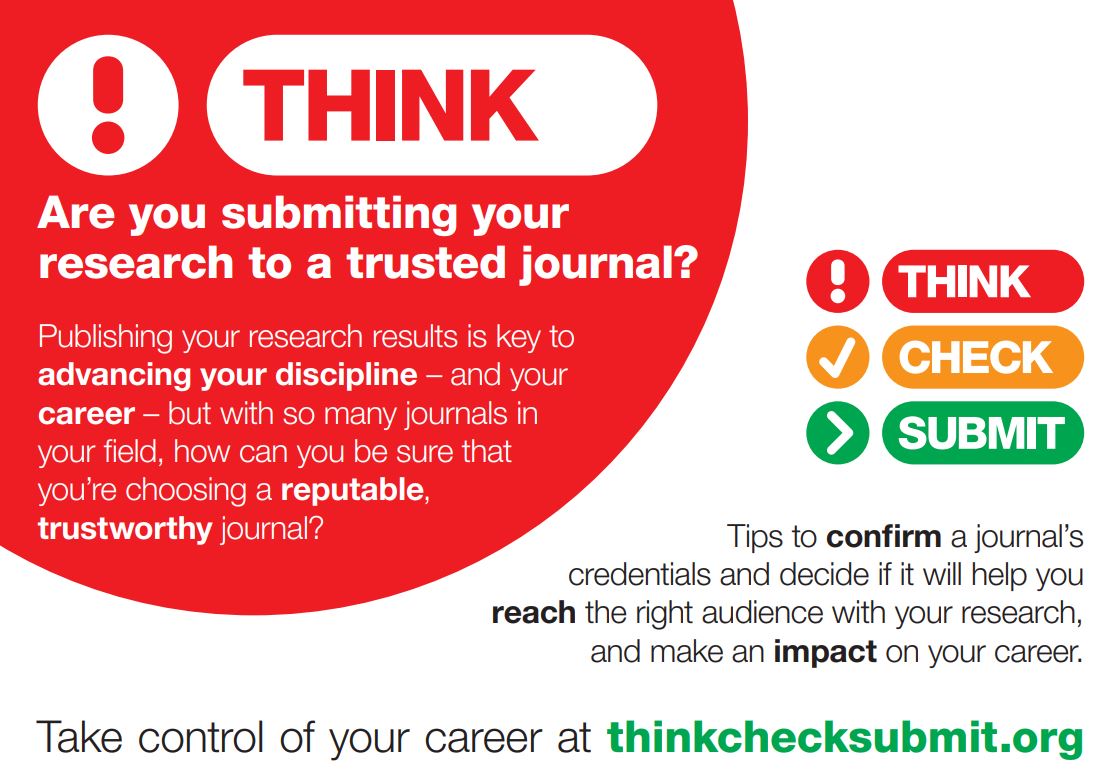
The good news is that there are resources available to help you make a good decision about which journal to publish in. Think. Check. Submit is one such tool aiming to help researchers identify trusted journals.
Books and book chapters can count as valid research output, but the guidelines are quite strict and very prescriptive.
For further information on the criteria, see the Research Output Reporting guide
If you want to gain maximum credibility and research impact you should choose a major scholarly publisher in your field.
Major publishers like Elsevier, Springer, Taylor & Francis, Oxford University Press, LWW, SAGE, ACS, Cambridge University Press and Wiley cover most academic disciplines but there are many others. A good guide is to find some very reputable recent books in your own field and see who the publishers are. The Library catalogue can be a useful tool in this search.
If you are asked to contribute a chapter to an edited monograph, it is best if it's a peer-reviewed volume. In many disciplines, peer-reviewed monographs or collections are as important as journals.
Conference papers can count as valid research outputs, but the guidelines are quite strict and very prescriptive.
In general only full peer-reviewed papers count (not posters, abstracts etc.).
For further information on the criteria, see the Research Output Reporting guide
Conference posters are another way that researchers can connect with their community.
Note that conference posters are not eligible for RPDC or ERA reporting (see the Research Output Reporting guide).
Some good resources for preparing conference posters are:


This work is licensed under a Creative Commons Attribution-NonCommercial-ShareAlike 3.0 Unported License.